Press Record, Not Panic: Drafting Out Loud When the Cursor Wins
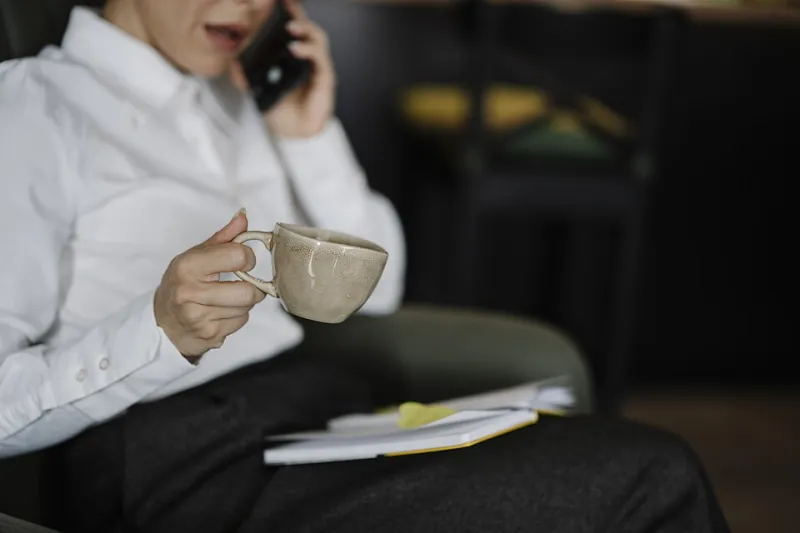
Photo: Shixart1985, CC BY 2.0, via Wikimedia Commons
The cursor blinks. You have rewritten the first sentence eleven times. The document is still empty except for a title you're not sure about, and somewhere in the last two hours you have alphabetized your spice rack and read a thread about a man who built a cabin in Montana.
I know this room. I've spent a lot of my life in it. The thing that finally got me out wasn't discipline or a better outline. It was pressing record on my phone and talking to nobody in particular for four minutes.
The blank page is a bad interviewer
Writing is answering a question nobody asked, in a voice that has to be perfect on the first try, with no facial expression to help you. It's a hostile setup. Talking is different. Talking to a friend on a walk, or into a phone on a highway at 7:40 in the morning, is the most natural drafting state we have. Nobody freezes mid-sentence when they're explaining something to a friend. They just talk, and the argument builds itself as they go.
That's the whole trick. Get the argument out loud first, then worry about whether the sentences are good.
Ramble on purpose
Open your phone's voice memo app. Set a five-minute timer. Start talking about the thing.
It will be bad. Good. It's supposed to be. The first two minutes are you clearing your throat: “Okay, so this piece is about how I think the whole idea of a personal brand is actually…” Keep going. Don't stop to fix. If you stall, say the stall out loud: “I don't know how to say this part.” Nine times out of ten, the thing you can't say is the actual idea, and describing why you can't say it is the way in.
Capture the thing before it evaporates
Every good idea I've had in the last year has arrived in one of three places: the shower, the car, and the fifteen seconds before sleep. None of those are desk environments.
So the routine is dumb and it works:
Put the voice memo app on your home screen. Not in a folder. On the screen. The friction of hunting for an app is enough to lose the idea.
Record in the margins. Walking to the train, sitting at a red light (phone in a dash mount, hands on the wheel — be an adult about this), waiting for coffee. Five minutes is a long time; you rarely need it.
Say the idea twice. Once as a mess, once as a summary: “The point is X, and the reason it matters is Y.” That second version is the seed of your outline, and it takes eight seconds.
The bar is not “good recording.” The bar is “it exists somewhere other than my head.”
The weekly triage
Once a week — I do it Friday afternoons — I listen back at 1.5x speed with a notebook. Most of it is garbage. Maybe one in five recordings has a keeper sentence, and one in twenty has an actual idea.
For the keepers, I transcribe. Any transcription tool works; the free ones on your phone are fine. I usually retype the good parts by hand because the act of typing forces me to decide what actually mattered. Either way, what you want is text you can cut.
Turning the mess into a draft
Here's the part that surprises people: the transcript is not a draft. It's closer to a quarry. You chip away at it.
Delete everything that was thinking out loud — the “um,” the “I don't know,” the false starts. What's left is usually the skeleton of an argument, in the order you actually believe it. Then write the real draft from that skeleton, in your normal writing voice. You'll find you're not starting from zero anymore. You're starting from something you already said out loud, which is the only place writing ever really starts.
The other gift of the transcript: it contains the line you said twice. That's almost always your opening sentence. You didn't know it when you said it, which is exactly why it sounds like you.
When it doesn't work
Sometimes you record five minutes and it's flat. That's information, not failure. It usually means the idea isn't ready, or it's actually a different idea wearing a disguise. Park the recording and come back in a week. Half the time you'll hear the real piece in there and wonder how you missed it.
Try it on the next one
The next time you have a piece to write, don't open a document. Open the recorder. Talk for five minutes like you're explaining it to a smart friend in a diner. Then take the mess and shape it.
The blank page will still be there when you get back. It'll just have less power over you.