Would You Still Care in 2035? The Decade Filter That Saves Creative Careers
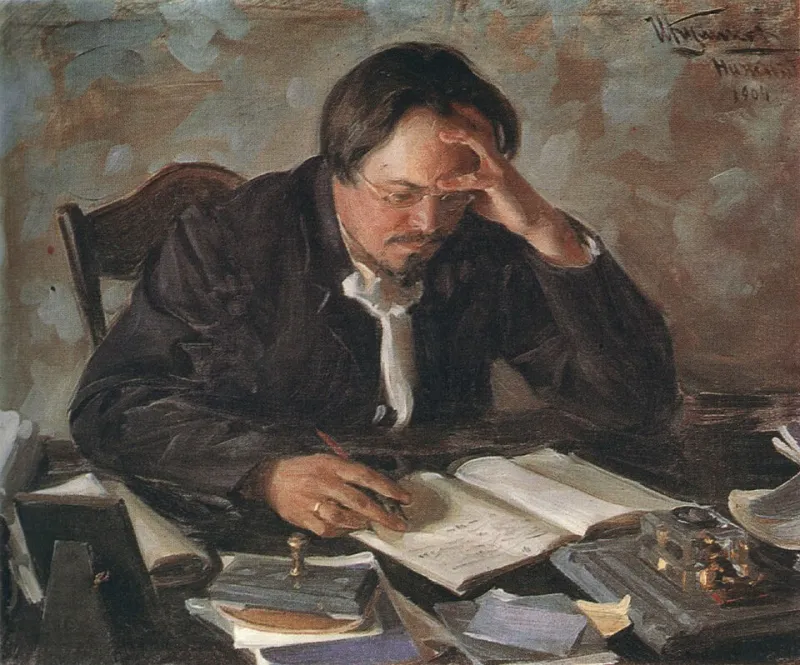
Photo: Ivan Kulikov, Public domain, via Wikimedia Commons
A few years back, I nearly signed on to co-write a novel with a friend of a friend. The premise was electric. The pitch meeting went great. I could already see the finished book in my head.
Then I asked myself one question: Would I still want to be working on this in ten years?
The answer, it turned out, was no. Not because the idea was bad — it wasn't. Because he was wrong for me, the process would've been miserable, and the kind of book it was meant to be wasn't the kind of book I wanted to spend a decade near.
I walked away. It stung for about two weeks. Then the relief set in, and it never left.
Most Projects Are Longer Than You Think
Here's the math nobody does before saying yes: a novel takes two to four years. A screenplay, if it sells, takes two more to actually reach a screen — if it ever does. A podcast with real ambitions? Think in seasons, which means years. A personal brand? That's you, forever.
We treat creative commitments like they're dates when they're actually marriages. And just like marriages, the cost of the wrong one isn't the time you spend — it's the time you don't spend on the right one.
So before you commit, run the idea through what I call the Decade Filter. Three questions. Be brutally honest, because the idea will lie to you.
Question One: Does It Generate Energy or Eat It?
Every project has a honeymoon phase where everything is new and shiny and your brain floods you with dopamine just for showing up. That phase tells you nothing. The real question is what the project does for you in month fourteen, when the shine is gone and you're deep in the unglamorous middle.
Here's a test you can actually run: spend two weeks on the project — real work, not planning, not mood boards, actual output. Then check your battery. After a session, do you want to keep going, or do you need to recover?
Some projects are energizers. Even the hard parts — the research, the revisions, the admin — feel like they're feeding you. Others are vampires. They take and take, and you tell yourself it's supposed to feel this way because that's what real work feels like.
It's not. Real work is hard, but it shouldn't hollow you out. If two weeks in you're already negotiating with yourself about whether to continue, that's data. Listen to it.
Question Two: Is This Obsession or Infatuation?
There's a difference between being excited about an idea and being obsessed with it, and the difference matters enormously over a decade.
Infatuation is about the outcome: the book on the shelf, the film festival premiere, the launch tweet going viral. It's about who you'll be after.
Obsession is about the work itself: the sentence you can't stop untangling, the character who keeps talking to you in the shower, the problem you research at 11 p.m. because you genuinely can't help it.
Outcomes are unreliable motivators. They're also mostly out of your control. The market decides whether your book sells. Critics decide whether your film lands. But the daily texture of the work? That's yours, every single day, for years.
So ask: if success were guaranteed to be modest — a small readership, a quiet release, a modest paycheck — would I still want to do this? If the answer is yes, you've got obsession. If the answer is "well, only if it really hits," you've got a lottery ticket, not a project.
Question Three: Does It Have Staying Power?
Some ideas are snacks. Some are meals. A rare few are cuisines — whole worlds you can keep cooking in for decades.
Ask yourself whether the idea scales with you. Will the theme still interest you in five years, when you're a different person? Does it have enough depth that you won't exhaust it by year two? Could it branch — into a series, a body of work, a practice — or is it a one-shot deal?
This isn't a knock on one-shot projects. Sometimes a snack is exactly what you want. But know what you're ordering. Don't treat a snack like a meal, and definitely don't sign a decade of your life over to one.
The Fine Print: Walking Away From Seductive Opportunities
Here's the hard part. The projects that eat your best years are rarely the bad ones. They're the seductive ones — the ones with a great premise, an impressive collaborator, a whiff of prestige, or a genuine shot at money.
The seductive ones come with a voice that says: you'd be crazy to pass this up. Do you know how many people would kill for this opportunity?
That voice is doing arithmetic with someone else's values. An opportunity is only an opportunity if it's an opportunity for the thing you're actually trying to build. A great gig that pulls you off your path isn't a stepping stone. It's a detour with good lighting.
When you feel that pull, get specific. Write down what saying yes costs you — not in generalities, but in concrete terms: the months it takes, the projects it displaces, the energy it drains. Then write down what it gives you. Sometimes the math works and you say yes with open eyes. Often, once you see it on paper, the seduction deflates.
And when you walk away? Do it clean and do it early. A quick no is a kindness to everyone involved — including the version of you who gets to keep working on what matters.
Run the Filter Before You Need It
The worst time to evaluate a decade-long commitment is after you've already started. The sunk cost kicks in, your identity gets tangled up with the project, and suddenly quitting feels like admitting failure rather than exercising judgment.
So make the Decade Filter a habit. Before you say yes to anything big — before the outline, before the handshake, before the group chat — sit down with the three questions: energy, obsession, staying power.
Ten years is a long time. Spend it on things that are worth a decade to you.